
Foreign Punctuation in a Korean Help Screen
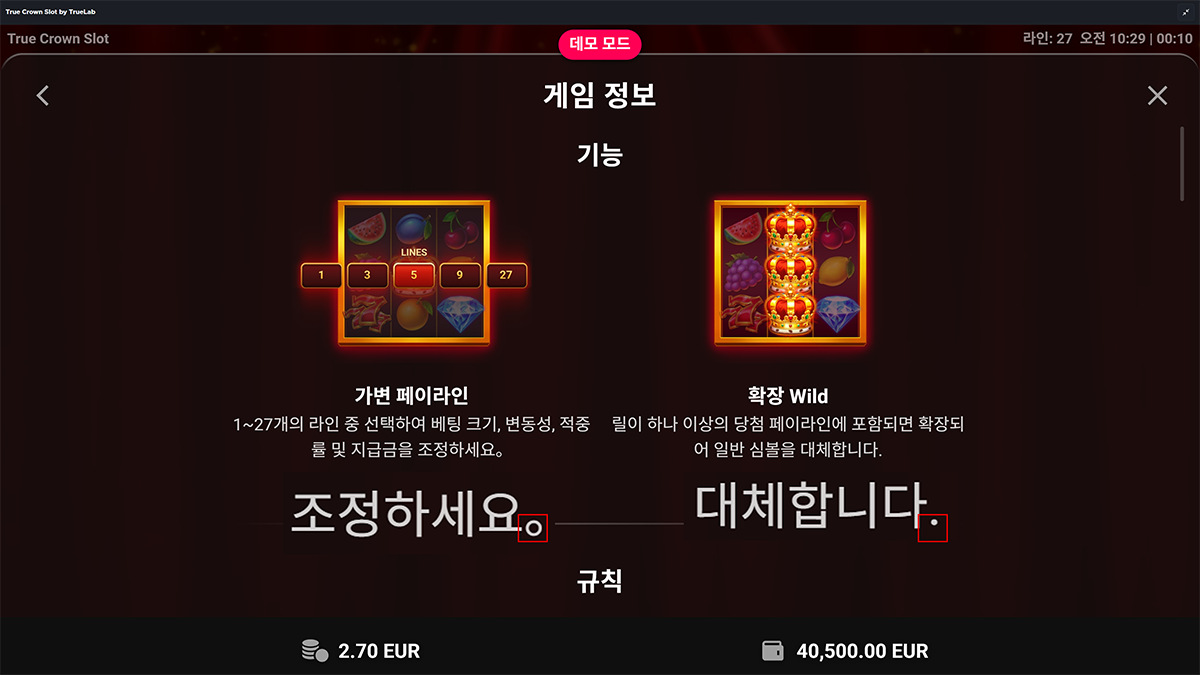
On the Korean help screen of True Crown Slot, one description ends 조정하세요。 while the adjacent one ends 대체합니다. A Japanese- or Chinese-style full stop sits beside the ordinary period used in Korean. The contrast makes the inconsistency visible on a single screen.
The Issue
In True Crown Slot by TrueLab, the adjustable paylines description on the left ends 조정하세요。. The expanding Wild description beside it ends 대체합니다. The first uses the East Asian full stop 。; the second uses ., the ordinary period in Korean text.
Both instructions remain understandable, but two descriptions side by side follow different punctuation conventions. Their short length and matching placement make the inconsistency especially visible.
Analysis
Someone typing an ordinary Korean sentence is unlikely to enter 。 by accident. The mark can enter when output conventions or resources from different locales are mixed. Processing several languages together through AI translation can also produce this kind of leakage.
The neighboring 대체합니다. has the appropriate period. This is therefore not a uniform punctuation style applied to the entire game: the two strings on one screen were handled inconsistently. Mixing Simplified and Traditional Chinese is a different visible error, but it can arise from the same failure to keep locale-specific output separate.
Possible Solutions
Change 조정하세요。 to 조정하세요., matching the neighboring 대체합니다. The adjacent sentence makes the intended convention clear.
Keep locale resources and punctuation rules separate, and flag 。 when it appears in Korean strings. Automated checks help, but the final help screen also needs to be read as a whole so neighboring instructions use consistent punctuation.
Scope of the Issue
The observed mark appears in one Korean help sentence in True Crown Slot. The underlying issue concerns how multilingual text is generated and managed so that each locale retains its own script and punctuation.
If that separation fails, other builds can also inherit Korean punctuation or marks from a third language. The same type of control failure can surface where two writing standards, such as Simplified and Traditional Chinese, must be kept distinct. This calls for review across localized builds.
Potential Risks
One punctuation mark can look trivial in a bug list while remaining conspicuous to readers of the language. It can leave a persistent sense that even this sentence was not checked on the final screen.
If these traces recur, players may start questioning other translated instructions. The mark does not break a feature by itself, but it can erode confidence in the game's finish and in the producer behind it.