
Lucky Ri, Lucky Ari: Broken Korean Text Escapes Review
In the Korean version of Mahjong Wilds Link&Merge, the Fortune Pot appears as 리 in an opening instruction and 아리 in the help screen. Several syllables are also missing from the feature explanation. The two screens contain different versions of a broken sentence that a basic language review should have caught.
The Issue
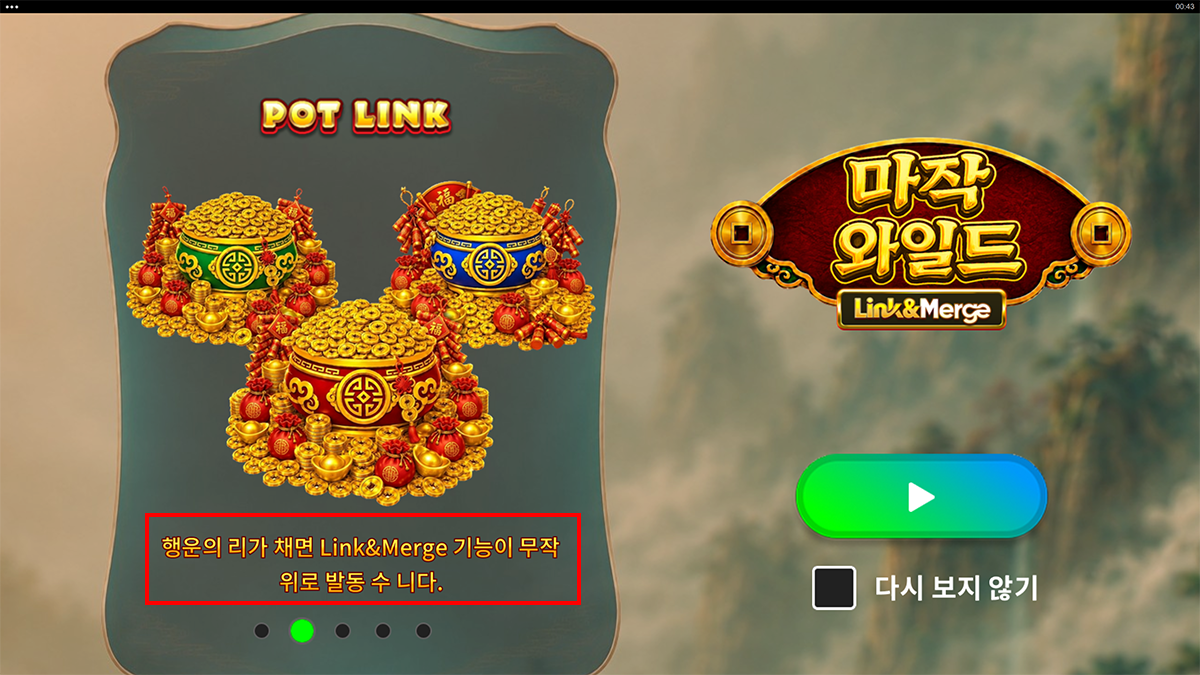
The opening instruction in Mahjong Wilds Link&Merge by Microgaming says Filling a Fortune Pot may randomly trigger a Link&Merge feature. The Korean screen reads, ignoring its line break: 행운의 리가 채면 Link&Merge 기능이 무작위로 발동 수 니다.
Where the source names a Fortune Pot, Korean shows only 리, a fragment with no identifiable meaning in this context. 채면 and 발동 수 니다 also appear to have lost syllables. The sentence meant to explain how the feature may activate is broken at several points.
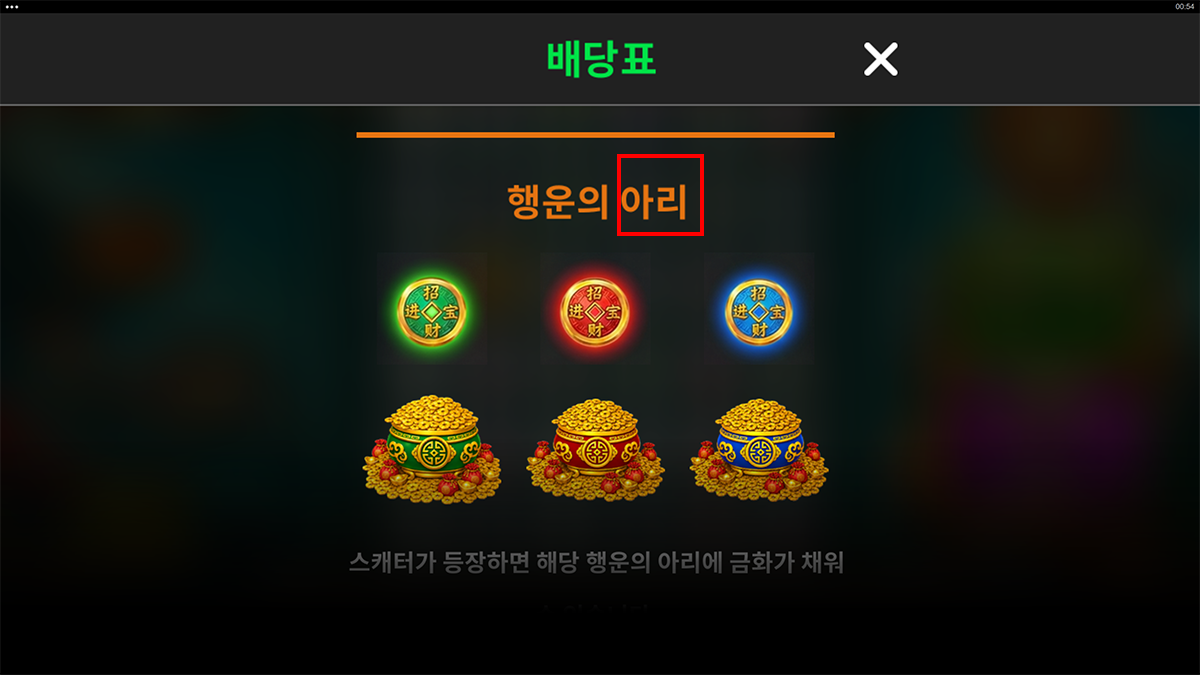
The help screen calls the same object 행운의 아리. Neither 리 nor 아리 is a usable Korean name for the Fortune Pot. The fragments differ between screens, and 행운의 아리 appears again in the help text below the heading.
Analysis
Different numbers of syllables appear to be missing from 리, 아리, 채면, and 발동 수 니다. This is difficult to explain as one mistyped word. The producer needs to trace the text through the translation draft, localized resources, and on-screen rendering to find where the characters disappeared. Whatever the stage, reading the shipped Korean screens once should have caught the result.
Even a complete literal rendering of may randomly trigger as 무작위로 발동될 수 있습니다 would be awkward Korean instruction text. 일정 확률로 발동합니다 would convey the practical point more clearly: the feature may activate with some probability. The primary failure here, however, is more basic than style: characters are missing from the displayed sentence.
Possible Solutions
Choose a meaningful Korean name for Fortune Pot, such as 행운의 항아리, and use it consistently in the opening instruction, help heading, and body. A clearer instruction would be 행운의 항아리를 채우면 Link&Merge 기능이 일정 확률로 발동합니다.—filling the Fortune Pot can activate Link&Merge with a certain probability.
Checking only the translation file is insufficient. Inspect the rendered game to ensure every syllable survives, compare the opening instruction with the help screen, and search other Korean strings for similar omissions. Trace any character loss between resource storage and display.
Scope of the Issue
The observed omissions occur in the Korean opening instruction and help screen of Mahjong Wilds Link&Merge. The website lists 12 language codes for the game: EN, CN, KO, TH, VI, ID, JA, RU, PT, TR, HI, BN. The screenshot does not mean that every other version contains the same fragments 리 and 아리. It does show that a central feature explanation shipped in broken form across two Korean screens in a game offered in twelve languages.
Other versions may contain different missing text, inconsistent feature names, or meaningless phrases. If the localized resources share a production and review process, this is a reason to check pre-release language QA across the multilingual builds.
Potential Risks
리 and 아리 are not even the same typo repeated twice. The screen gives little clue where or how the sentences were damaged, yet both different results reached the released game. Players can reasonably question whether the feature rules—or any of the game’s explanations—were reviewed.
The game is listed in twelve languages, which raises the stakes. If defects this conspicuous passed the final Korean screen review, the standard for reading and checking each localized build needs another look. For a game carrying the major Microgaming brand, translation-resource production, rendering, and final language QA all warrant review. One visible failure can prompt questions about the product and producer across many markets.