
When a Language Menu Displays the Flags of China and Taiwan Side by Side
A language selection screen shared across a producer's games displays the flags of China and Taiwan as separate options, yet labels both 中文. Players must guess from the flags which option uses Simplified Chinese and which uses Traditional Chinese.
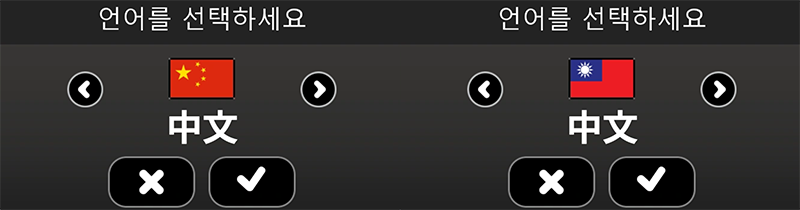
The Issue
Simplified and Traditional Chinese offer distinctly different reading experiences, but the menu does not name the difference. Instead, it presents the flags of China and Taiwan as the way to choose between them.
This is more than two language options sharing the same label. Politically sensitive national symbols are being used where writing systems should be distinguished. Because this is a shared layer rather than a screen made for one game, the design can recur across the producer’s titles.
Analysis
The Chinese government regards Taiwan as part of China and opposes representations that could suggest 'one China, one Taiwan.' Taiwan's government, meanwhile, rejects the People's Republic of China's claim of sovereignty over Taiwan. In this context, a menu displaying the two flags side by side can be read as more than a language selector. In mainland China, it may be taken to present Taiwan as a separate country.
Using either flag to stand for both writing systems would not solve the problem. Flags represent political entities; they do not denote Simplified and Traditional Chinese. The W3C also recommends using text instead of flags in language selectors.
Possible Solutions
Remove both flags from the language menu and label the options 简体中文 and 繁體中文. Keep the two writing systems distinct in the internal settings as well, and verify that each option opens the corresponding game screens and help text. The language tags zh-Hans and zh-Hant can distinguish the scripts.
After updating the producer’s shared layer, check every game that uses it. Fixing a single title could leave the same screen in the others.
Scope of the Issue
This is a shared localization design issue, not a mistranslation in one language. The problem was spotted in a Korean interface, but it was not caused by a Korean word choice. The two “中文” labels and their flags belong to the common screen players use to choose a language.
The Chinese options reveal a particularly sensitive consequence of that design. The review should therefore extend beyond the Chinese game text: it should check how every language is named and represented across the games and builds that use the same selector.
Potential Risks
The risk does not end with the producer. If an aggregator receives the games and supplies them to operators, the aggregator may be the first party asked to explain and correct the build and its shared UI that the operator actually receives. The party that created the issue and the party facing the customer’s request may be different.
If the same layer appears across several games, the impact extends beyond one title. By bringing the sensitive relationship between mainland China and Taiwan into a language menu, the design may force the aggregator to check the exposure of multiple supplied games and seek a coordinated fix from the producer. Players only need to know whether they are choosing Simplified or Traditional Chinese. The flags add little value, while the distribution burden they can create is much greater.