
Where Le Cowboy Loses Its Western Voice in Korean
The English help text for Le Cowboy builds a character out of Western idioms and absurd jokes. The Korean version follows much of the literal meaning but loses the momentum and humor. Even the rattlesnake gets an unfamiliar name, showing why this voice needs more than literal translation.
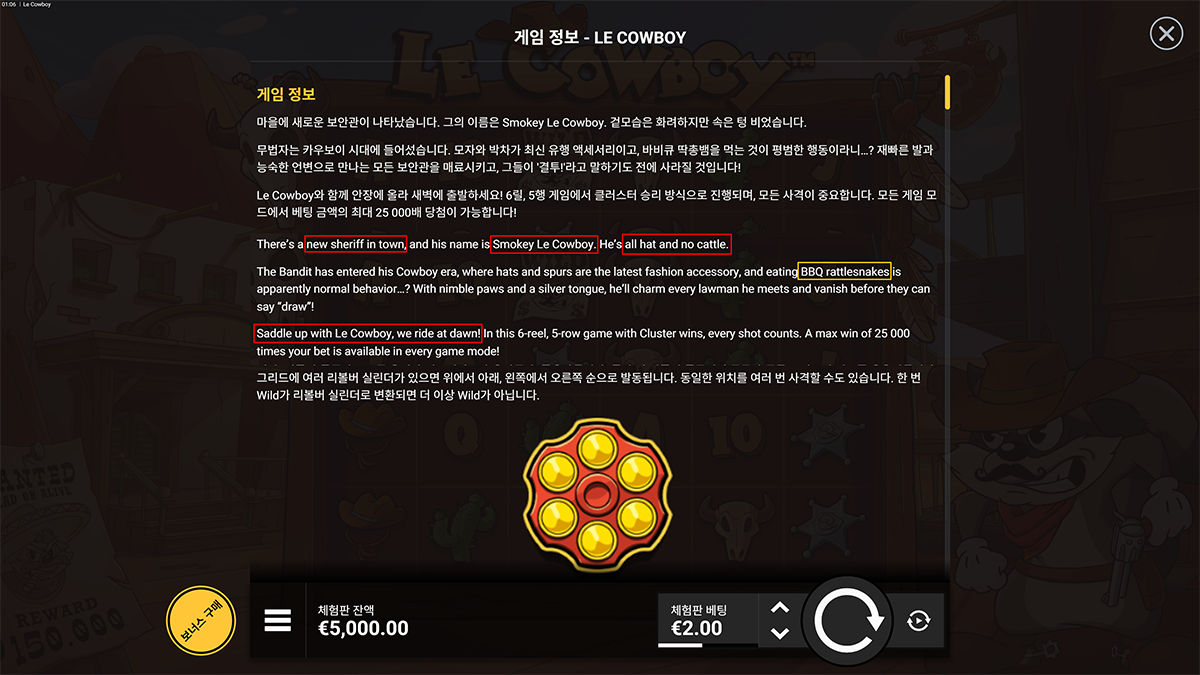
The Issue
The English help text in Le Cowboy by Hacksaw Gaming introduces the game in a Western voice: There’s a new sheriff in town, all hat and no cattle, and Saddle up ... we ride at dawn! The Korean version translates these as, roughly, A new sheriff has appeared in town, He looks flashy but is empty inside, and Get on the saddle and depart at dawn. Parts of the literal meaning survive, but the comic voice becomes plain exposition.
The same screen renders BBQ rattlesnakes as 바비큐 딱총뱀 (*barbecue ttakchong-snake*). Korean readers ordinarily know the animal as 방울뱀. This is a distinct problem from translating an idiom literally: an unfamiliar animal name obscures both the Western setting and the deliberately absurd image of barbecuing a rattlesnake.
Analysis
These lines are character copy, not a list of rules. Each expression does a different job in establishing the setting and Smokey’s persona. Picking dictionary equivalents one phrase at a time cannot carry those effects across.
There’s a new sheriff in town
There’s a new sheriff in town announces a change in who runs the place, with the swagger of a Western. The next paragraph calls the character The Bandit, adding a comic tension between sheriff and outlaw. The Korean sentence, A new sheriff has appeared in town, reports an arrival but loses the attitude. A colloquial line closer to There’s a new sheriff around here would better serve the scene.
The Name Smokey
Smokey is the recurring protagonist’s name across the Le series. Leaving a proper name intact is not the error. In a gun-slinging Western setting, however, its smoke associations can contribute to the character’s image. Those associations do not automatically travel with the name; the surrounding copy must help.
All Hat and No Cattle
All hat and no cattle is an established idiom for someone with cowboy swagger but no substance to back it up. Korean renders it as He looks flashy but is empty inside. This conveys some idea of pretension, yet removes the hat-and-cattle imagery that makes the line belong to this Western. Empty inside can also sound like a harsher judgment of the character than the playful jab in the source.
BBQ Rattlesnakes
Korean ordinarily calls a rattlesnake 방울뱀. Its warning rattle and association with the desert make it a vivid Western animal. Treating a rattlesnake barbecue as everyday food is part of the source’s absurd exaggeration. The Korean 딱총뱀 is not a recognizable common name for the animal, so readers must first puzzle over what creature the line means. Here the remedy is to restore the clear image of barbecued rattlesnake, not to invent a new pun.
Saddle Up, We Ride at Dawn
In Saddle up with Le Cowboy, we ride at dawn!, saddle up is a rousing Get ready! in cowboy language, while we ride at dawn sounds like a shared call to action. Dawn is atmosphere, not a timetable. The Korean Get on the saddle with Le Cowboy and depart at dawn! reads like instructions for mounting a horse and meeting a departure time. It also drops the inclusive we.
Possible Solutions
This screen needs new copy in each language that performs the same character voice, rather than one-to-one replacement of words. A localization brief should explain the scene, the speaker, and the effect of each idiom, alongside its literal meaning. Keep character names where appropriate, but give local writers room to choose their own colloquial phrasing, idioms, and rhythm.
In Korean, a line equivalent to A new sheriff has shown up around here can retain the opening swagger, and the closing line can be rewritten as a rallying cry rather than a travel instruction. These are directions for tone, not fixed translations. Replace 딱총뱀 with the recognizable 방울뱀, then have a local reader review the entire screen for a consistent voice.
Scope of the Issue
The observed case is the Korean help screen of Le Cowboy. The issue is not confined to one Korean word. The source combines Western idioms, cowboy imagery, associations around the character’s name, and a rousing call to action. Other languages handled through ordinary literal translation are likely to lose comparable parts of that voice.
The loss need not look the same everywhere. One locale may flatten the sheriff idiom, while another loses the hat-and-cattle joke or the rattlesnake image. Correcting one Korean string is insufficient; this calls for multilingual copy adaptation and review by readers of each locale.
Potential Risks
Distinctive English copy draws players into the world of Le Cowboy. Yet when lines built around English idioms and cultural imagery pass through an ordinary translation pipeline, a strength of the English version can become a quality gap elsewhere. The localized game may feel less lively than the original.
The choice is whether that character voice is a product feature for English speakers alone or for every market the game enters. If localization is meant to serve those markets, invest the time and budget to rewrite the copy for each language, with permission to use local colloquialisms and idioms. For a major producer such as Hacksaw Gaming, leaving so much of the game’s personality intact only in English wastes an asset it has already created.