
Common Localization Issues: Bet and Bet Amount
Localization issues tend to follow recurring patterns. We examine representative patterns and ways to improve them. Korean is our starting point, but similar issues can arise in other languages. Where possible, we use examples from larger providers, since an individual issue can have a more damaging effect on perceptions of a smaller provider’s overall quality. This article looks at both an individual provider’s wording and a HUD issue involving a shared platform. The focus is the meaning lost when Bet is borrowed into Korean as ‘베팅’. Although it is a familiar term in games, the translation should distinguish the act of wagering from the amount wagered.
English Bet and Korean ‘베팅’ Do Not Carry the Same Meaning
In English, bet can refer both to the act of wagering and to the money wagered. It is therefore natural to use Bet as a label for an amount in a slot interface, or as the reference amount when describing a win multiplier.
However, borrowing the sound of an English word does not automatically transfer all of its meanings into another language.
The Korean borrowing ‘베팅’ primarily names the act of wagering. Although it is associated with money, the act, ‘베팅’, and the amount, ‘베팅액’, are distinct. When the original refers to a specific amount, using ‘베팅’ alone does not explicitly convey that monetary meaning.
The issue is not phonetic borrowing itself. It is translating a word that denotes an amount while leaving only the name of an action in the localized text.
The Missing Meaning in ‘최대 25,000X 베팅 당첨’
This difference becomes more apparent in statements that calculate or compare amounts.
Gates of Olympus 2500 by Pragmatic Play provides a direct comparison between the English and Korean maximum-win messages.
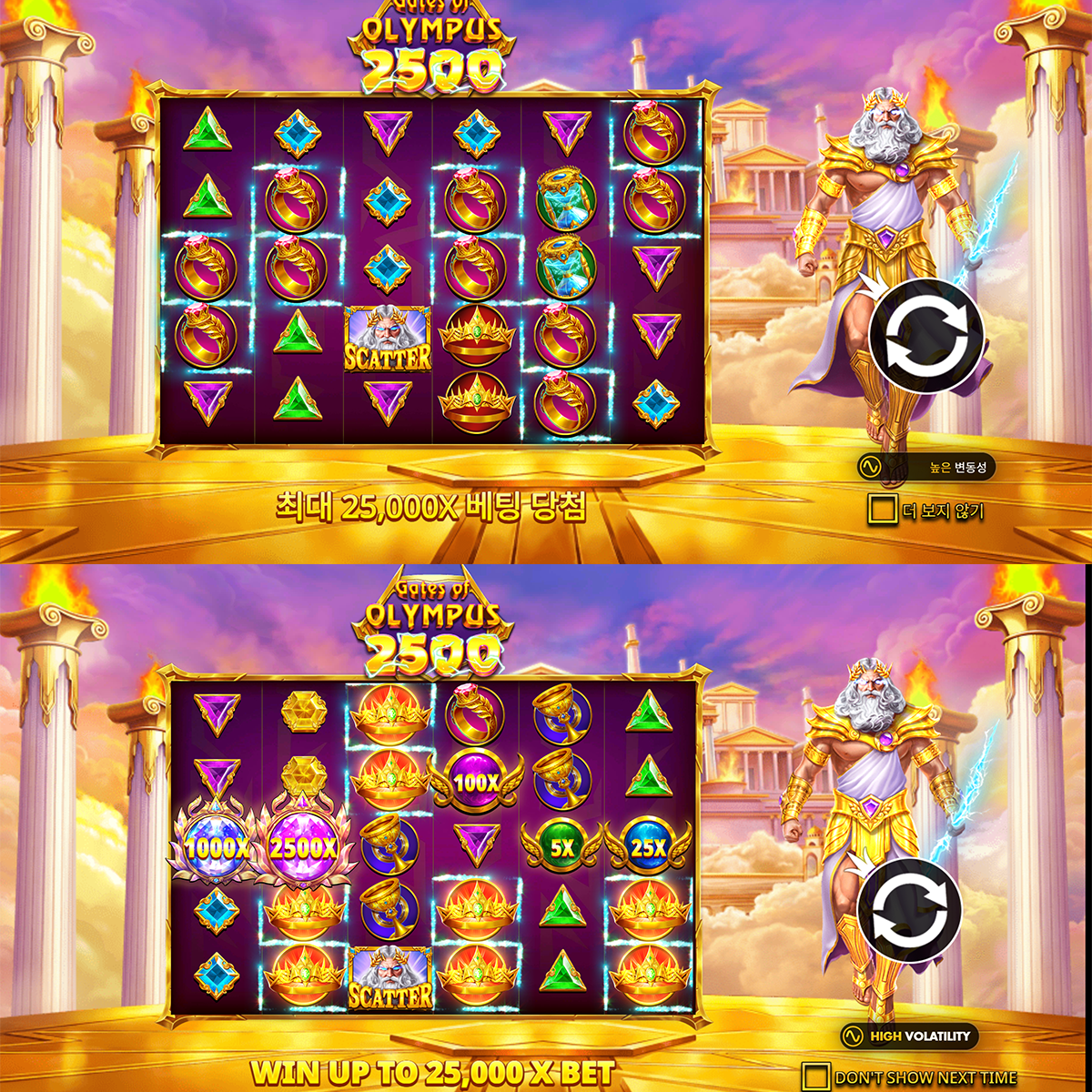
The English screen reads WIN UP TO 25,000 X BET. Here, bet is the monetary reference for the multiplier: a player can win up to 25,000 times the amount wagered.
The Korean screen renders this as ‘최대 25,000X 베팅 당첨’.
In English, bet denotes an amount and therefore provides the reference for ‘25,000 times’. The Korean borrowing ‘베팅’ does not directly denote an amount in the same position. Following the English words and their order leaves the reference amount and its relationship to the multiplier insufficiently expressed in Korean.
A more natural Korean expression is ‘베팅액의 최대 25,000배 당첨’, meaning ‘Win up to 25,000 times the bet amount’. ‘베팅액’ identifies the amount, and ‘의’ connects it to the multiplier.
The aim is not to reproduce the English word order, but to express the relationship between the bet amount and the win amount in Korean.
The same issue can occur in feature descriptions and bonus-buy messages. When explaining a purchase price as a multiple of the bet amount, or how that amount changes within a feature, the distinction between an action and an amount directly affects the explanation’s accuracy.
Context Alone Does Not Make a Translation Adequate
When a number and a currency symbol appear beside ‘베팅’, players can infer that it refers to an amount. Experienced slot players may also work out the intended meaning of a maximum-win message.
But this means surrounding information is compensating for meaning missing from the translation. It does not mean the translated word itself adequately conveys the original meaning.
If an expression is translated, the translation should convey the meaning required in that context. In statements about amounts and multipliers, the reference amount should be explicit.
‘베팅액’ and ‘베팅 금액’ do not introduce a new concept. They make explicit in Korean the monetary meaning already present in the English bet.
HUD Labels Remain Visible Throughout Play
In Corporation Wars by Kitsune Studios, the Korean HUD displays ‘체험판 잔액’ and ‘체험판 베팅’ side by side.
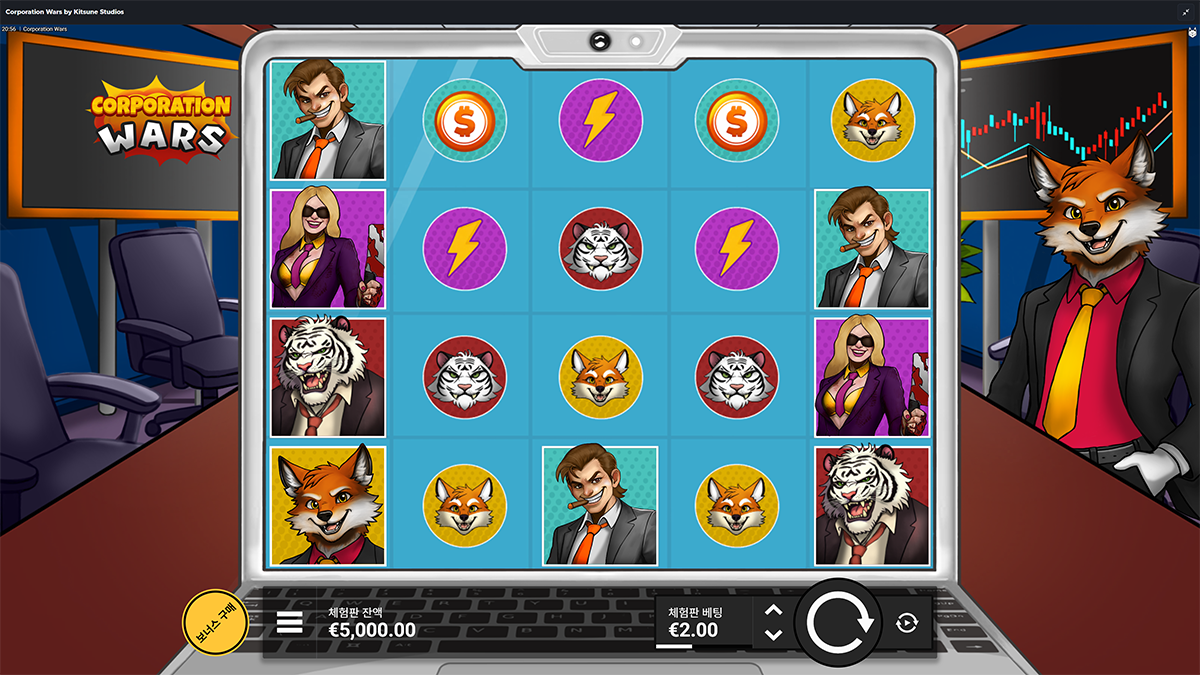
Both fields display monetary amounts. Balance is translated as ‘잔액’, a Korean word that identifies the type of amount, while Bet is borrowed as ‘베팅’, the name of an action.
Using translation and phonetic borrowing together is not itself a problem. The problem is that one of two adjacent monetary fields clearly names the amount it displays, while the other fails to express that monetary meaning. ‘체험판 베팅액’ or ‘체험판 베팅 금액’ would be more appropriate here.
The issue extends beyond the HUD. Help text, feature descriptions, win messages, and any other in-game wording that uses bet to mean an amount should also be reviewed. The HUD makes the issue particularly noticeable because its labels remain visible throughout play.
Unlike a description read once and dismissed, the bet amount is information players repeatedly check and adjust. Awkward or insufficiently explicit wording in that position remains in view during the game.
Does Every HUD Label Need Translation?
This also raises a broader question: does every HUD label need to be translated?
For information such as balance and bet amount, which can be readily understood through position, numbers, currency units, and controls, retaining familiar original labels is an option. If translation produces awkward fonts, text sizes, alignment, or spacing, the visual loss can outweigh the benefit of localized wording. The HUD remains on screen throughout play.
This does not mean context makes an inaccurate translation acceptable. Deciding whether translation is necessary and deciding whether a translation is accurate are separate questions. For an item that remains intuitive in its original form, both the benefit of translation and its visual cost should be considered.
A localized HUD with accurate wording, appropriate fonts, and a natural layout is desirable. But without that quality, translation can make the interface worse.
HUD localization should be judged by how naturally players can read and use the information, rather than by how many labels have been translated.
Translate the Meaning Required in Each Context
Do not fix a translation solely on the basis of the source word Bet or Betting. First identify what it refers to.
- The act of wagering: 베팅, 베팅하다
- The amount wagered on a spin: 베팅액, 베팅 금액
- The reference amount for a win or cost multiplier: 베팅액의 ○배
Japanese can be reviewed in the same way. Where an amount is meant, expressions such as ベット額 or 賭け金 make that meaning explicit. Borrowing bet as ベット is not, by itself, sufficient reason to conclude that the required meaning has been conveyed.
Chinese likewise offers a distinction between 投注 and 投注额, allowing the wording to reflect whether the text describes an action or specifies an amount.
The words differ by language, but the test remains the same: does the expression convey what the original refers to in that context?
Why Borrow Wild but Make the Bet Amount Explicit?
Our separate article on Wild, Scatter, and Free Spins examines how replacing familiar borrowed feature names with literal translations can make them harder to understand.
Bet provides the opposite example. Borrowing its pronunciation in a context that requires a monetary amount does not adequately convey the original meaning. An explicit amount term is more appropriate.
Both examples illustrate the same principle.
Localization is not the mechanical transfer of a word’s meaning or sound. It is the selection of an expression that conveys the contextual meaning to local players.