
An Uneven Source Sentence Turns Free Spins into a Free Game
A short comparison of win ways in the base game and Free Spins became a reference to a free game in Korean. The source sentence connects the two conditions unevenly, and an attempt to make them parallel in translation changes the name of a feature.
The Issue
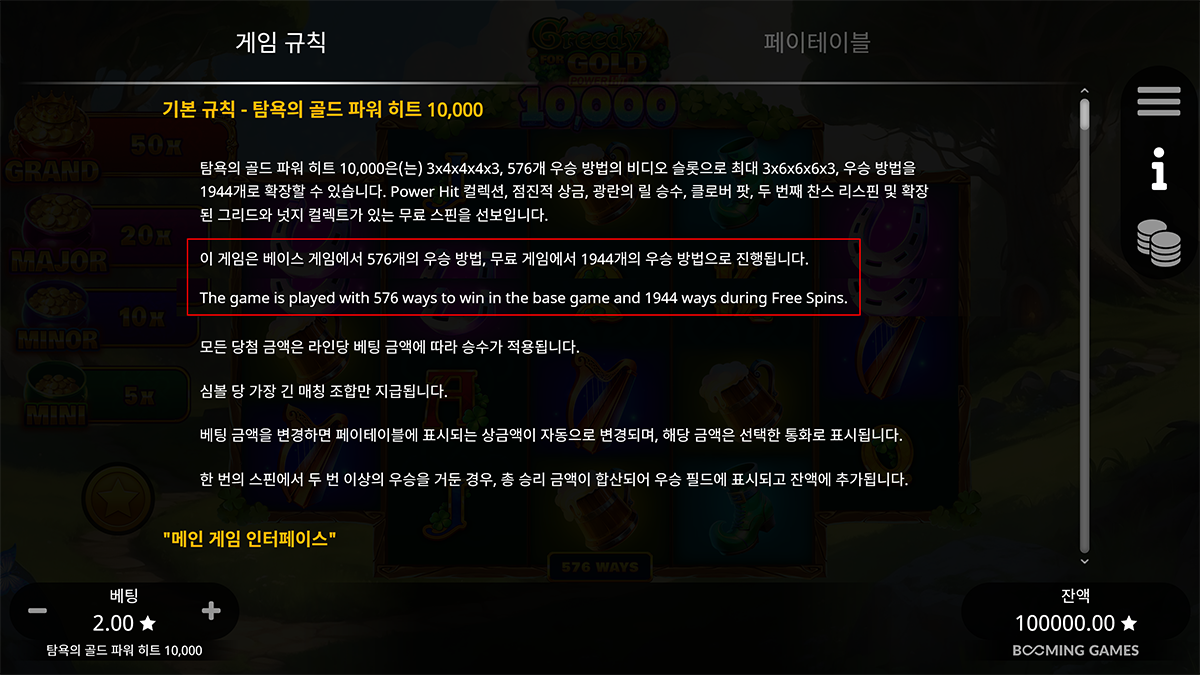
The rules for Greedy for Gold: Power Hit 10,000 by Booming Games compare 576 ways to win in the base game with 1,944 during Free Spins. The English sentence reads: The game is played with 576 ways to win in the base game and 1944 ways during Free Spins.
The Korean version says, in effect, This game is played with 576 ways to win in the base game and 1,944 ways in the free game. The phrase free game is a mistranslation of Free Spins. It suggests a different kind of game where the text should name the Free Spins feature, making the rule confusing even to a reader familiar with slots.
Analysis
The source joins in the base game and during Free Spins in one comparison. Neither phrase is ungrammatical, but they frame the two conditions differently: the first names a game mode, while the second names a period during a feature. Opening with The game is played with ... further complicates what should be a simple comparison of two counts. Omitting to win after the second ways is ordinary English ellipsis; the problem is the overall shape of the sentence, not that omission itself.
The Korean version makes the clauses more parallel: in the base game ... / in the free game .... The effort to balance them is understandable, but it turns the feature name Free Spins into free game. It also renders ways to win as something closer to methods of winning a contest, rather than win ways in a slot. An awkward source structure and poor term choices compound each other.
Possible Solutions
The source can state the comparison directly: There are 576 ways to win in the base game and 1,944 during Free Spins. For a fully parallel form: The base game offers 576 ways to win; Free Spins offers 1,944. Both keep Free Spins as the feature name.
A natural Korean version would say, in effect, The base game offers 576 win ways; Free Spins offers 1,944. Specify Free Spins = 프리스핀 in the terminology guide, and check feature names and figures together on the final rules screen. When a source sentence is unclear, clarify what is being compared before asking translators to reconstruct its structure.
Scope of the Issue
The observed mistranslation, free game, appears in Korean. The sentence that feeds the translation, however, is a shared English source. When the base game and Free Spins are described with mismatched structures inside one sentence, translators into other languages must decide how to reconstruct that relationship too.
The Korean result is specific, but the source-text problem is localization-wide. Some versions may retain an awkward literal structure; others may create a new error while trying to make the comparison read naturally.
Potential Risks
The Korean translator's effort to give the two conditions a cleaner parallel structure deserves credit. The risk is the chain of errors that starts when translators have to repair a poorly designed source. A literal rendering can preserve its awkwardness; a rewrite can introduce a different mistake, as happened here when a feature name changed.
Fixing only the Korean string leaves the shared cause in place. Clarify the source sentence and feature name first, then review the localized versions against the corrected source. Otherwise, each language may fill the same gap differently, leaving inconsistent rules across builds.