
One Feature, Three Names: The Hold & Spin Terminology Problem
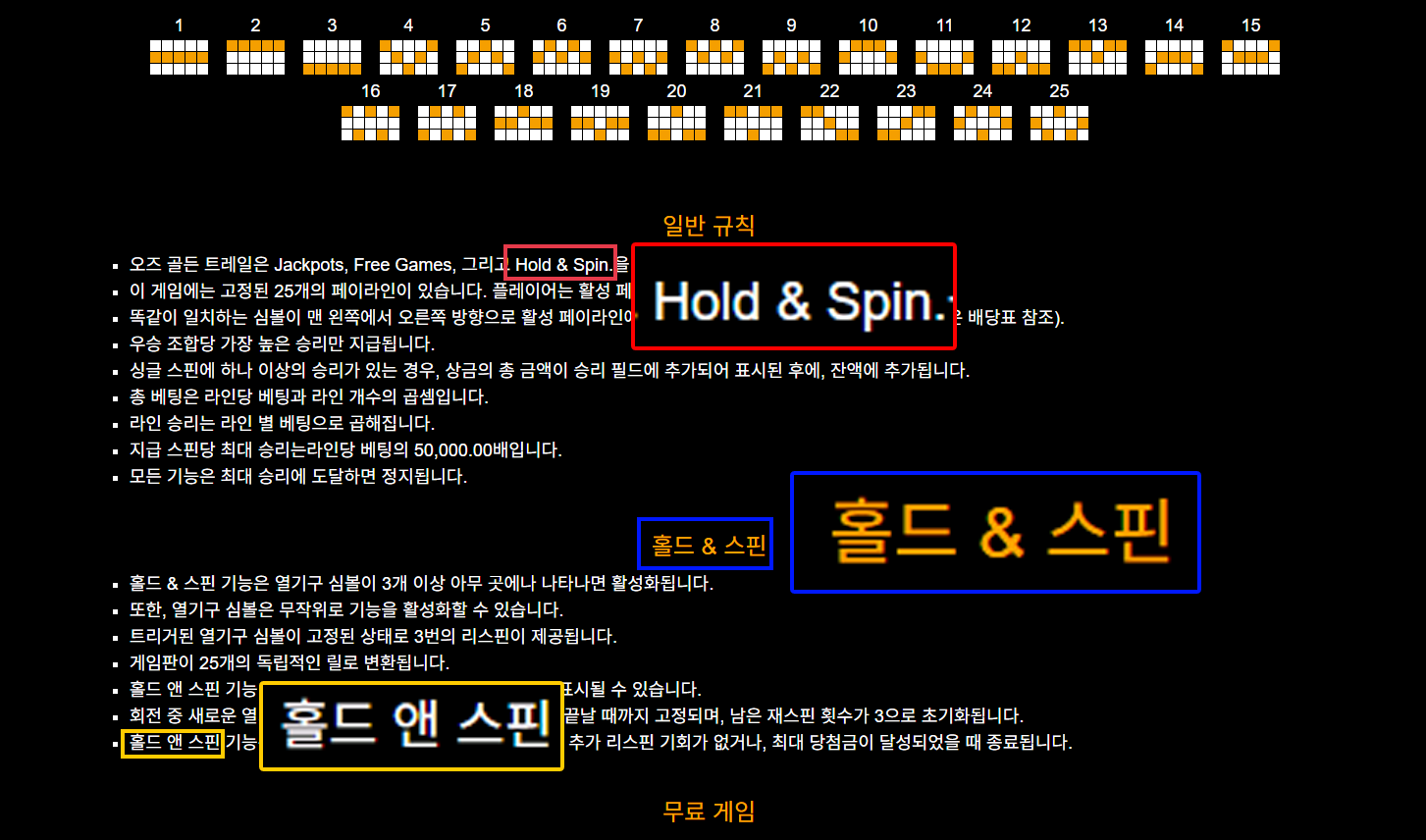
In the Korean help screen of Oz Golden Trail, the same Hold & Spin feature appears under three different names. A player reading the rules has to work out that all three refer to the same feature.
The Issue
In Oz Golden Trail by RTG, the general rules say Hold & Spin. The feature heading says 홀드 & 스핀, with the words transliterated into Korean but the ampersand retained. The following descriptions say 홀드 앤 스핀, spelling out “and” in Korean as well. These are three names for the same feature on one screen.
They do not describe three different modes. A player must recognize each as the same feature while moving between the general rules, the heading, and the detailed instructions. The help screen adds work where it should remove uncertainty.
Analysis
Each form is individually recognizable, but the combined screen has no stable name for a branded feature. The general rules, feature heading, and detailed instructions appear to have entered translation as separate resources without a shared term rule, or without a final in-context review that reconciled them.
The inconsistency also affects search and support. Players may use any of the three names when looking for an explanation or describing a problem. A feature name is the link between the game screen, the rules, and support materials.
Possible Solutions
Choose one approved name for Hold & Spin in each language. In Korean, 홀드 앤 스핀 could be used throughout. If the English name is retained as a branded term, use Hold & Spin everywhere instead. Apply that choice to the general rules, heading, detailed instructions, and related pop-ups.
Record the term in the glossary and translation memory, then read the finished help screen as a whole. This matters especially when translation is automated: individual strings can be rendered differently, but the shipped game should use one name.
Scope of the Issue
The observed case is one Korean help screen in Oz Golden Trail. Its cause is not a Korean word in isolation: it is how the same feature name is managed across separate rule, heading, and description resources. If those resources are translated and assembled independently for other languages, the same drift can appear there too.
This is a localization-wide terminology and in-context QA issue, with Korean providing a clear visible example.
Potential Risks

RTG states in its notice that materials in languages other than English were machine translated. Automation makes human review and a clear terminology policy more important, yet a core feature still has three names on one help screen. When other language errors also recur in the producer's games, players and distribution partners may question not only the translations but its ability to deploy and manage AI-assisted localization. The shipped result does not show effective term control or final review.
The same notice says translations are provided for players who cannot read English. Players may prefer game information in their own language regardless of their English ability. Saying for players who prefer to read game information in their own language conveys the purpose without casting the audience as deficient. That wording also shapes how local players feel the producer regards them.