
Hot and Cold Streaks Happen in Slots, and That’s Just Math
Can a slot really be due for a win? We look at how streaks emerge and what they mean for the next spin.
Of course, that doesn’t mean a slot is “due to pay” after you’ve lost. Under the same game conditions, your previous losses do not make the next spin more likely to win.
Even so, it can feel as though a slot has a rhythm of its own. After a long stretch without a meaningful win, a big payout may arrive and feel like a reward for sticking with the game.
Hot and cold streaks can appear in the results. They don’t change the odds of the next spin.
We’re not talking about collection features or other mechanics explicitly described in a game’s rules. We’re talking about the belief that losses build up until a win becomes more likely. Let’s look at why that belief feels convincing—and how slot outcomes actually work.
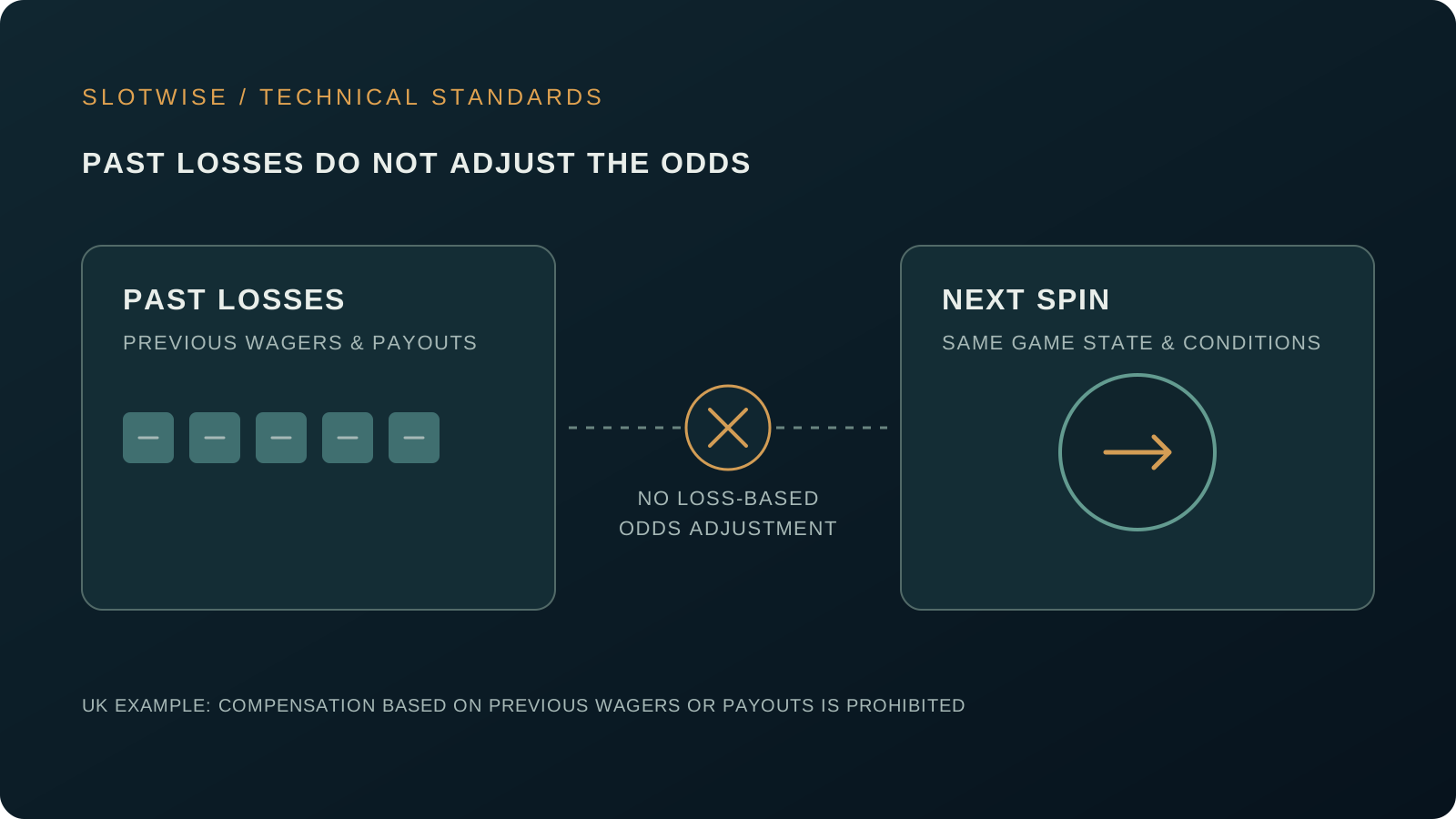
Adjusting the Odds to Compensate for Losses Conflicts With Technical Standards
Commercial online slots offered in major regulated markets are tested against the technical standards of the markets in which they operate. Those tests examine matters such as the randomness and unpredictability of outcomes, and whether a game operates according to its intended probabilities.
For example, the UK Gambling Commission defines a *compensated game* as one that adjusts the likelihood of winning based on previous amounts wagered or paid out. Its technical standards prohibit this type of compensation. A game that increases your chance of winning because you have already lost a certain amount would fall under that principle. Definition of terms · RTS 7
In other words, this is more than an assumption that a developer probably wouldn’t add such a system. To meet the relevant UK standard, a game must not adjust its odds to make up for previous losses.
RTP doesn’t represent money a slot owes you, either. It is a theoretical expected return derived from the game’s probabilities and payout structure. If your personal results fall below the stated RTP, the difference does not accumulate inside the slot as an unpaid balance waiting to be returned.
There Is No Need to Build Such a System
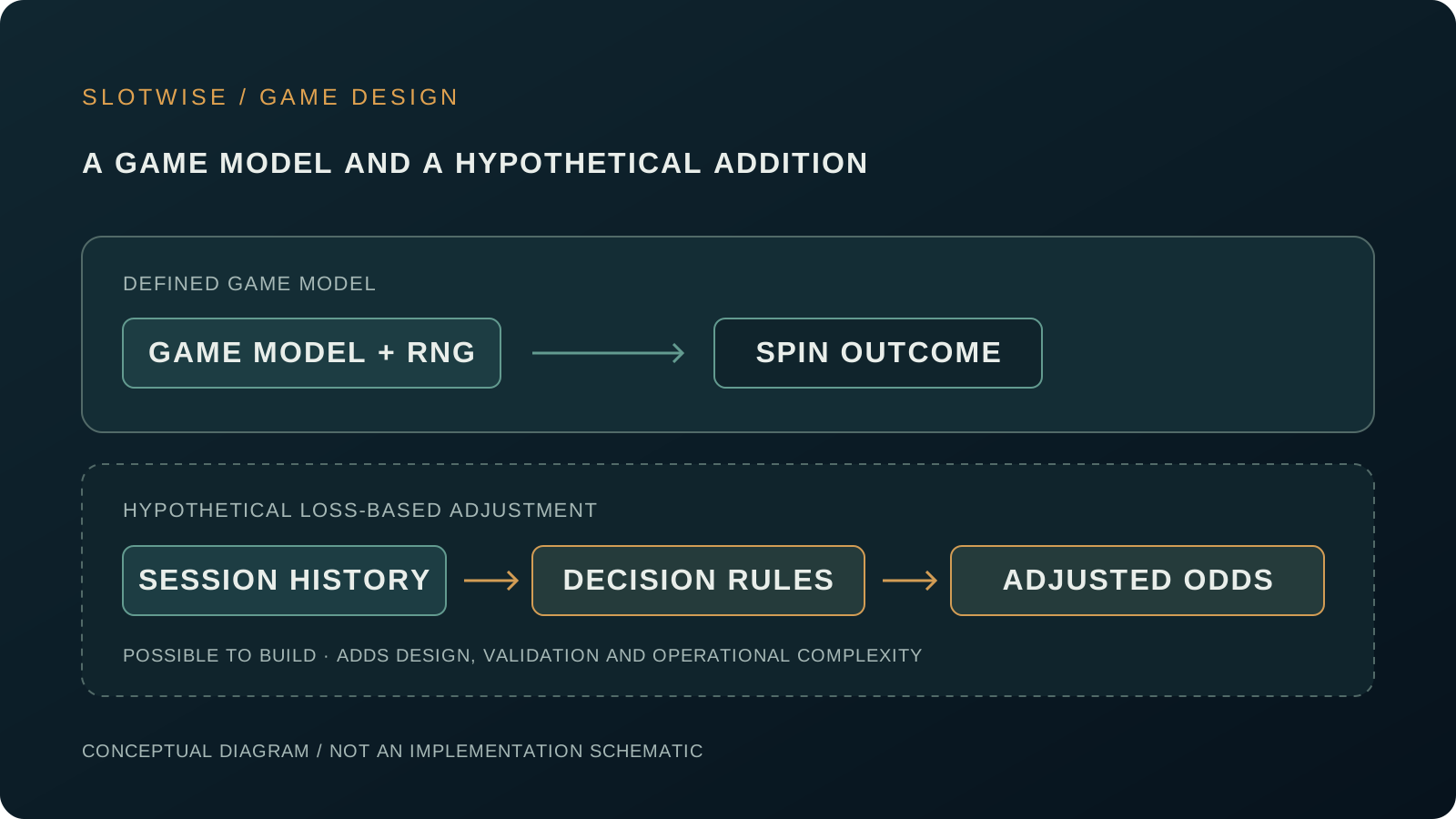
Let’s set certification aside for a moment and imagine a system designed to compensate for losses.
From a player’s perspective, the session in front of them is the one that matters. From the operator’s perspective, however, many players may be playing the same slot at the same time, generating a continuous stream of transactions.
A loss-based compensation system would need rules for deciding whose losses to consider, when compensation begins, and how much the odds should change. It would also need to account for sessions ending, bet sizes changing, and the effect of those adjustments on the game’s overall payout structure.
Such a system could be built. But recording transactions and using those records to adjust probabilities in real time while keeping the game’s overall behavior under control are different tasks. The latter adds complexity to design, testing, and operation.
An RNG-based slot already produces outcomes according to its game state and mathematical model. Its probabilities and payouts can be designed to provide an expected long-term return without tracking individual losses and adjusting the odds to compensate for them.
So, even apart from certification requirements, there is little practical reason to add a loss-compensation system.
Why Do Streaks Feel Real?
Imagine a game in which each spin has a 10% chance of a win.
That does not mean you will win once after nine losing spins. It does not even mean you are guaranteed one win in every ten spins. It means that each spin has a 10% chance of winning.
You could win on the first spin. You could win several times in a row. Or you could experience a long stretch without a win. If nine spins in a row produce no win, the chance on the tenth spin does not increase. Under the same game conditions, it is still 10%.
The same idea applies to a Big Win. A Big Win has its own probability, but previous losses do not increase it. You might see one on your first spin, or you might play hundreds of spins without seeing a meaningful win.
When you look at those results in sequence, though, patterns appear: a stretch where wins cluster together, a stretch where losses pile up, or a large win at the end of a long losing run.
It is natural to experience those as hot and cold streaks. After all, the wins and losses—and the changes in your balance—really did happen.
The mistake is treating a pattern in past results as a mechanism that influences the next result.
Winning After a Loss Is Not the Same as Winning Because of It
Suppose a Big Win arrives after a long run of losses. It is easy to connect the two events:
“It kept taking my money, and then it finally paid. It was due.”
But “a win came after a long losing run” and “a win came because of a long losing run” are different statements. One event occurring before another does not mean it caused the other.
Under the same conditions, when spins are independent, each spin produces its outcome without being affected by the losses before it. The losses did not build toward a threshold that made the eventual win happen.
Instead, once the win appears, it gives the preceding losses a shape. The losses did not create the win; the win made the earlier losses look like part of a streak.
There are also sessions where the big win never arrives and the player’s balance runs out. Someone who believes in streaks may explain that away by saying the slot simply wasn’t ready to pay yet. If a win confirms the belief and a loss only means it is still too early, every outcome can seem to support the same story. That does not make the story a reliable way to predict what comes next.
Losses are not a deposit toward your next win. Playing longer gives you more opportunities to encounter a win, but the fact that you have already lost does not make the next spin more favorable.
Hot and cold streaks happen in the results. They do not change the odds of the next spin.